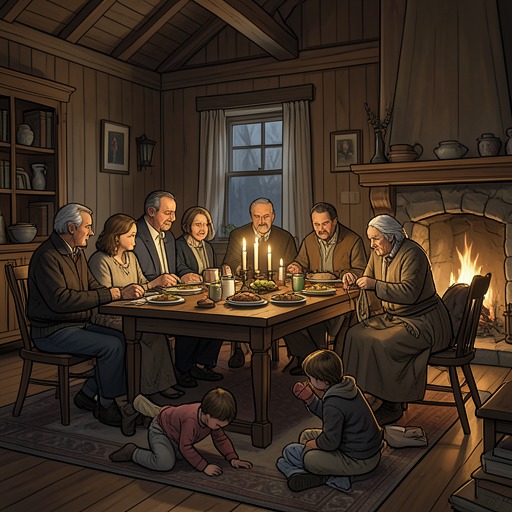
Prince Nikolai Bolkonsky
War and PeacePrince Nikolai Bolkonsky is the aging patriarch of Bald Hills, a former general in chief whose authority rests on discipline, intellect, and habit rather than warmth or social charm. Known in society as “the King of Prussia,” he has chosen to remain in the country even after Emperor Paul’s exile no longer prevents his return to the capitals. His life is organized around activity so exacting that it becomes a moral system, while his attachment to Princess Mary remains the emotional dependence he cannot openly acknowledge. His decline and death during the French invasion expose the human vulnerability beneath that formidable structure.
Identity and Household Order
At Bald Hills, Prince Nikolai Bolkonsky lives continuously with Princess Mary and her companion, Mademoiselle Bourienne. The anticipated arrival of Prince Andrei Bolkonsky and his wife does not initially disturb the estate’s established routine: the household continues according to the old prince’s timetable, as though family news and the movements of the wider world must submit to his private regulations. He insists that anyone who wishes to see him may travel the hundred miles from Moscow to Bald Hills, while he himself needs neither people nor the capital. The remark expresses both pride and a deliberate withdrawal from society.
He defines human vice and virtue in starkly practical terms. Idleness and superstition are, in his view, the two sources of vice; activity and intelligence are the two virtues. He has made these principles the basis of Princess Mary’s education, teaching her algebra and geometry until she was twenty and arranging her life so that her time would remain occupied. His own days follow the same doctrine. He writes his memoirs, solves problems in higher mathematics, turns snuffboxes on a lathe, works in the garden, and supervises the constant building at his estate. Activity is not merely something he performs; it is the means by which he keeps disorder, dependence, and perhaps grief at a distance.
Regularity gives this system its visible form. He comes to table under precisely the same conditions, at the same hour and even the same minute. He is sharp and invariably exacting toward everyone from Princess Mary to his serfs. Yet the narrative does not reduce him to a hardhearted tyrant: although he is not hardhearted, he inspires the fear and respect that many genuinely cruel men fail to command. His severity is inseparable from competence, endurance, and a powerful sense of responsibility.
Father and Daughter
The daily encounter between Prince Nikolai Bolkonsky and Princess Mary reveals how his authority operates at its most intimate. Every morning she enters the antechamber at the appointed time, crossing herself and silently praying that the interview will pass well. The old manservant quietly announces her, and through the door comes the regular hum of the lathe. The study itself resembles an extension of its master’s mind: books and plans cover the large table, locked bookcases stand ready for use, an elevated writing desk permits work while standing, and tools and shavings surround the lathe in orderly profusion.
When Princess Mary enters, he continues working after glancing at her. The small foot in a silver-embroidered Tartar boot and the firm pressure of his lean, sinewy hand show that old age has not yet deprived him of vigor. He never gives his children a blessing. Instead, he holds out his still-unshaven cheek, regards her tenderly and attentively, and then speaks severely, asking whether she is quite well and directing her to sit down. He immediately turns to the geometry exercise book he has written himself and assigns the next lesson. Affection therefore appears through procedure rather than declaration: the lesson, the examination, and the repeated morning ritual are his guarded language of care.
His control extends even to Princess Mary’s correspondence. When he discovers a letter addressed in a woman’s hand, the sight produces red patches on her face. He asks whether it is from Julie, permits two letters to pass, and threatens to read the third because he suspects she writes nonsense. The exchange is intrusive and stern, but it also shows a father who monitors the possibility of his daughter’s emotional life because he cannot easily imagine relinquishing his authority over it.
Marriage, Separation, and Resistance
The arrival of Prince Vasili Kuragin and Anatole Kuragin forces Prince Nikolai Bolkonsky to confront a question he has habitually suppressed: whether he can part with Princess Mary by giving her to a husband. The visitors annoy him, and he dismisses Prince Vasili as a shallow braggart while reserving judgment on Anatole. Yet beneath his irritation lies the knowledge that Prince Vasili has brought his son with the evident intention of proposing marriage.
The old prince cannot directly ask whether he is willing to let Princess Mary go, because he knows that an honest answer would conflict with both his feelings and the practical possibility of life. Life without her, despite the small value he appears to place on her, is unthinkable to him. He doubts that anyone would marry her for love, fearing that her plainness and awkwardness would leave her valued only for her connections and wealth. He invokes the existence of women who remain unmarried and perhaps happier, but this reasoning is also a defense against the separation he dreads.
Even so, he does not reject the proposal merely because it threatens his possession of her. He acknowledges that Anatole’s birth and position are acceptable and tells himself that he has nothing against the match if Anatole proves worthy. The decisive phrase is not a declaration of approval but an examination: “That is what we shall see!” His judgment of Anatole becomes an attempt to convert emotional resistance into a test of character. The scene shows the contradiction at the center of his paternal attachment: he wants Princess Mary protected, but his protection is so bound to control that her independence appears as a personal loss.
Grief and the Collapse of Authority
After the Battle of Austerlitz, Prince Nikolai Bolkonsky receives no certainty about the fate of Prince Andrei Bolkonsky. For two months the family waits while searches and diplomatic letters fail to locate him. A report says that the Russian army retreated after brilliant engagements, and the old prince understands that this official language means defeat. Then Mikhail Kutuzov writes that Prince Andrei fell before his eyes with a standard in his hand at the head of a regiment, calling him a hero worthy of his father and his fatherland, while admitting that it remains uncertain whether he is alive.
The old prince receives this news alone in his study. The next morning he follows his customary walk, but his silence toward the steward, gardener, and architect reveals that the routine has become a shell around catastrophe. When Princess Mary enters at the usual hour, he is still working at the lathe and does not look around. Then he throws down the chisel and speaks in an unnatural voice. The wheel continues revolving by its own impetus, and its dying creak becomes inseparable in Princess Mary’s memory from the announcement that follows. He cannot deliver the news calmly; he screams that Prince Andrei is killed, as if the force of the sound could drive away both his daughter and the unbearable fact.
Princess Mary does not faint. Instead, the news produces a strange brightening in her eyes, a joy beyond ordinary worldly joys and sorrows, suggesting the spiritual ambiguity of grief when uncertainty finally ends. Prince Nikolai Bolkonsky’s response is different: he turns away with a sob. The man who has controlled time to the minute cannot control the news that has entered his household. The lathe, emblem of continuous work and self-command, keeps moving after his hand has stopped.
War, Illness, and Death
During the French invasion of Russia, Prince Nikolai Bolkonsky first responds to danger by intensifying the habits that have defined him. After Yakov Alpatych returns from Smolensk, the old prince seems to awaken from apathy. He orders the peasants to be called up and armed, writes to the commander in chief that he has resolved to remain at Bald Hills to the last extremity, and declares that one of Russia’s oldest generals will be captured or killed there. At the same time, he instructs that Princess Mary, Dessalles, and the little prince leave for Bogucharovo and then Moscow.
This apparent contradiction—remaining to defend the estate while sending his family away—shows his attempt to preserve both military honor and paternal responsibility. Princess Mary, alarmed by his feverish sleepless activity, refuses to leave him for the first time in her life and thereby disobeys him. His fury erupts into a storm of accusations: he says that she has worn him out, caused his quarrel with his son, harbored nasty suspicions, and made it her life’s object to poison his existence. He drives her from the study and says he does not wish to remember her existence. Yet the fact that he does not order her carried away by force gives her hope that, beneath the violence, he is glad she has remained.
The old prince’s body soon betrays the authority his will tries to maintain. After the little prince has left, he dresses in full uniform, wears all his orders, and prepares to visit the commander in chief. His caleche waits outside while he goes into the garden to review the armed peasants and domestic serfs. Then frightened men rush toward the house, supporting and dragging him. The military costume and decorations cannot prevent the transformation from commander to helpless patient.
When Princess Mary is summoned to his room, Prince Nikolai Bolkonsky lies propped high on the bed, his hands small and bony, the veins purple and knotted. One eye looks straight ahead while the other turns awry; his brows and lips scarcely move, and his face seems to have shriveled or melted. He presses Princess Mary’s hand, having evidently waited for her, and struggles to speak through a failing tongue. His angry twitches and timid, imploring gaze reverse the familiar relation between them: the father who once directed geometry lessons and household life now depends on his daughter’s effort to understand him.
At his death, Princess Mary crosses the threshold and initially refuses to believe that he is gone. When she kisses his cheek, tenderness gives way to horror at the unfamiliar body before her. The women wash the corpse, tie the mouth and legs, dress it in uniform with its decorations, and place it on a table. Candles burn around the coffin, juniper is spread across the floor, and a chanter reads the psalms. The ceremonial uniform preserves the outward identity of the general, but the shriveled body makes visible the dissolution of the force that once governed Bald Hills.
Narrative Significance
Prince Nikolai Bolkonsky joins private character and historical structure. His life is shaped by the conviction that activity and intelligence can master disorder, yet the novel places that conviction beside forces no individual can command: Prince Andrei’s uncertain fate, the approach of the French army, the evacuation of Bald Hills, bodily illness, and death. His personal routines therefore do not stand outside history; they are a household-scale form of resistance to it.
His character also complicates the idea of patriarchal authority. He is domineering, suspicious, and capable of inflicting emotional pain, but he is not presented as simply cruel. His exactness produces fear and respect, his education of Princess Mary reflects genuine intellectual seriousness, and his guarded tenderness appears through repeated acts rather than sentimental language. The same attachment that sustains their household becomes the source of his resistance to her marriage and separation.
The treatment of his death is deliberately concrete. The narrative lingers over the lathe’s movement, the failing gestures of his hands and face, the washing and binding of the corpse, the uniform, the coffin, the juniper, and the psalms. Familiar authority is made strange through the body’s physical transformation. What had seemed permanent—the father at his table, the general in his orders, the ruler of a perfectly timed estate—becomes a vulnerable human form surrounded by the practical rites of death. His ending thus gives emotional and material shape to the larger novel’s insistence that historical power and individual will are both real, yet neither can escape the conditions imposed by time, war, and mortality.